Solar battery price: what a home battery costs, size by size
The government's own figures for home batteries registered with MCS put the middle installed price at £1,300 per kWh for small batteries, £890 for 6 to 11 kWh and £630 above that, with fitting and 0% VAT (to 31 March 2027) included. Slide to the size you are pricing.
Per nominal kWh, median of 42,903 batteries in DESNZ's 2025/26 sample. Source: DESNZ battery statistics, published 28 May 2026, checked 3 November 2026.
Modelled installed price, at 0% VAT (to 31 March 2027)
about£
About £8,800 for a 10 kWh battery.
Same job invoiced from 1 April 2027: about £9,200 (5% VAT on the same pre-VAT price).
- Median
- £890/kWh
- Mean
- £870/kWh
- This size
- £876/kWh
What this figure assumes
- Prices come from DESNZ's official statistics on home batteries registered with MCS in existing homes, April 2025 to March 2026 (published 28 May 2026).
- They include the battery, fitting it and connecting it to the supply. Solar panels, extended warranties and other building work are not in them.
- Every figure is per nominal kWh, the size on the label. Usable capacity is often lower, which raises the price per usable kWh.
- A median is the middle quote: half of recorded installs cost more per kWh, half less. DESNZ does not publish the spread, so this tool shows no range.
- Between the three bands the price follows a smooth line through each band's typical size (how the curve is drawn).
Three numbers decide most battery quotes
Quick answer: a home battery fitted in an existing UK home cost a median of £1,300 per kWh under 6 kWh, £890 per kWh from 6 to 11 kWh and £630 per kWh from 11 kWh, in the year to March 2026. Multiply by the size you are pricing, expect half of all quotes to land above that figure, and remember that the panels are not in it.
Those three medians are the backbone of this site. They come from the Department for Energy Security and Net Zero, which publishes the cost of every battery that installers register with MCS (the certification scheme for small-scale energy kit) in a home that already existed. In 2025/26 that came to 44,033 batteries, up from 24,242 the year before. Nobody selling batteries chose these numbers, which is why we use them and nothing else as the benchmark.
What the figures cannot tell you is the spread. DESNZ publishes a median and a mean for each band, not a low and a high, so any range you see quoted as "the" range for battery prices comes from somewhere else. Where this site gives a secondary figure it says so: Which?, for instance, puts battery storage at anything from under £2,000 to £10,000, and calls installation "upwards of £2,000".
Battery prices per kWh, by size band
Small batteries were the only band to get dearer per kWh in 2025/26. The middle band barely moved and the large band rose a little, while the number of large batteries recorded more than doubled.
| Size band | Median 2025/26 | Mean 2025/26 | Median 2024/25 | Batteries in 2025/26 sample | Share of sample* | Average size* |
|---|---|---|---|---|---|---|
| Under 6 kWh 1 to 5.99 kWh | £1,300 | £1,280 | £1,080 | 16,270 | 37.9% | 5.1 kWh |
| 6 to 11 kWh 6 to 10.99 kWh | £890 | £870 | £910 | 14,457 | 33.7% | 9.8 kWh |
| 11 kWh and over 11 to 29.99 kWh | £630 | £670 | £590 | 12,176 | 28.4% | 15.5 kWh |
Why we draw a curve instead of multiplying
Multiply 10.9 kWh by the middle band's £890 and you get roughly £9,700. Multiply 11 kWh by the large band's £630 and you get about £6,930. A battery a fraction bigger would look nearly £2,800 cheaper, which no real quote does. That jump is the dashed line on the chart.
The calculator above avoids it. It places each band's median at the band's average size (5.1, 9.8 and 15.5 kWh in the 2025/26 sample) and joins the points with straight lines, so the price only ever rises with size. The full method, and its limits, are on the methodology page.
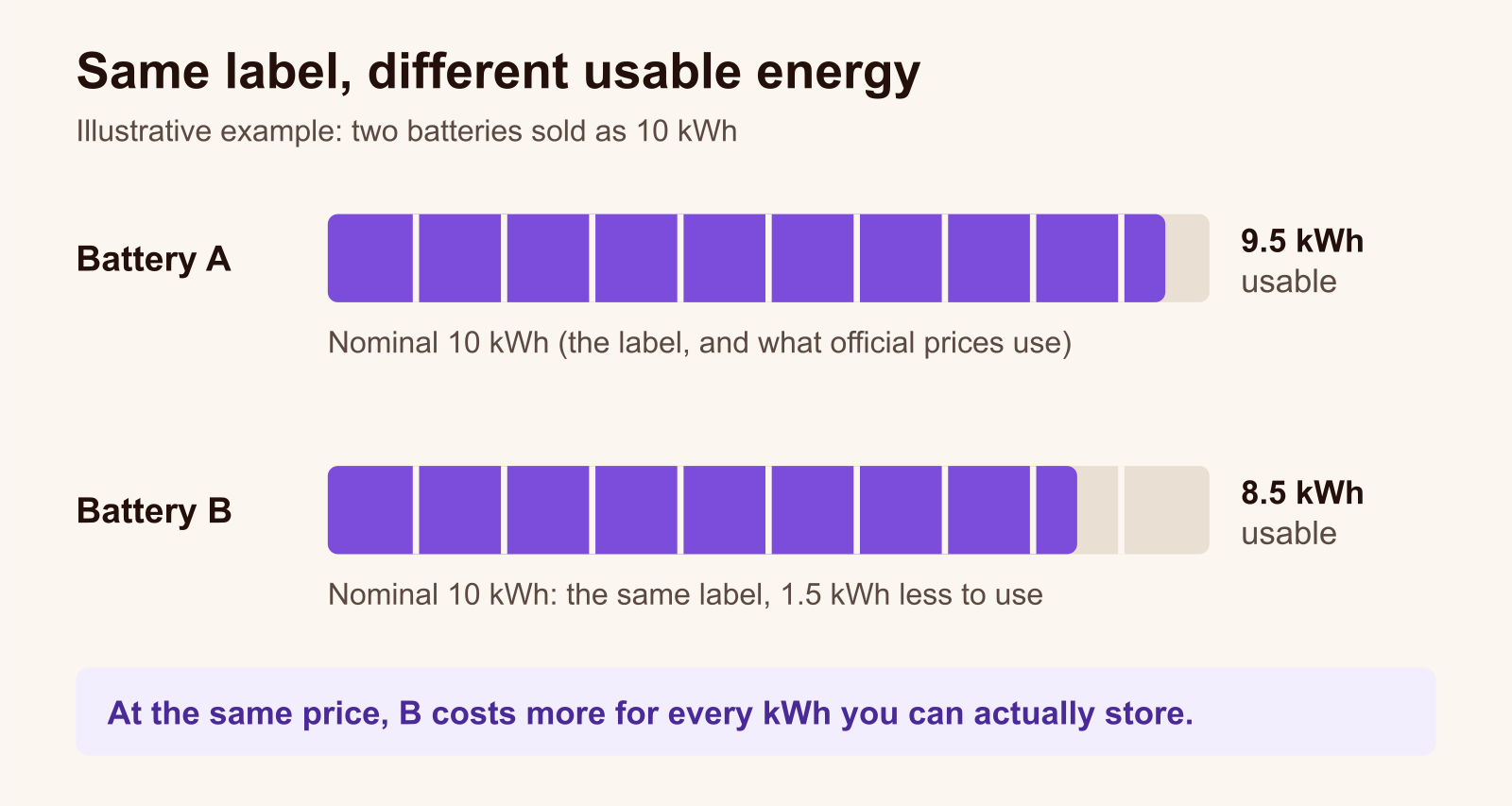
Prices are per nominal kWh, the capacity printed on the label. If a 10 kWh battery only lets you use 9 kWh, its price per usable kWh is a ninth higher than the figure here; the price per kWh page explains how to compare on usable and warranted capacity.
Why two quotes for one battery size can be far apart
Two households can ask for a 10 kWh battery and get quotes thousands of pounds apart without either installer doing anything wrong. The size is only one line of the bill. These are the items that move it, each covered in depth on what adds to a battery quote:
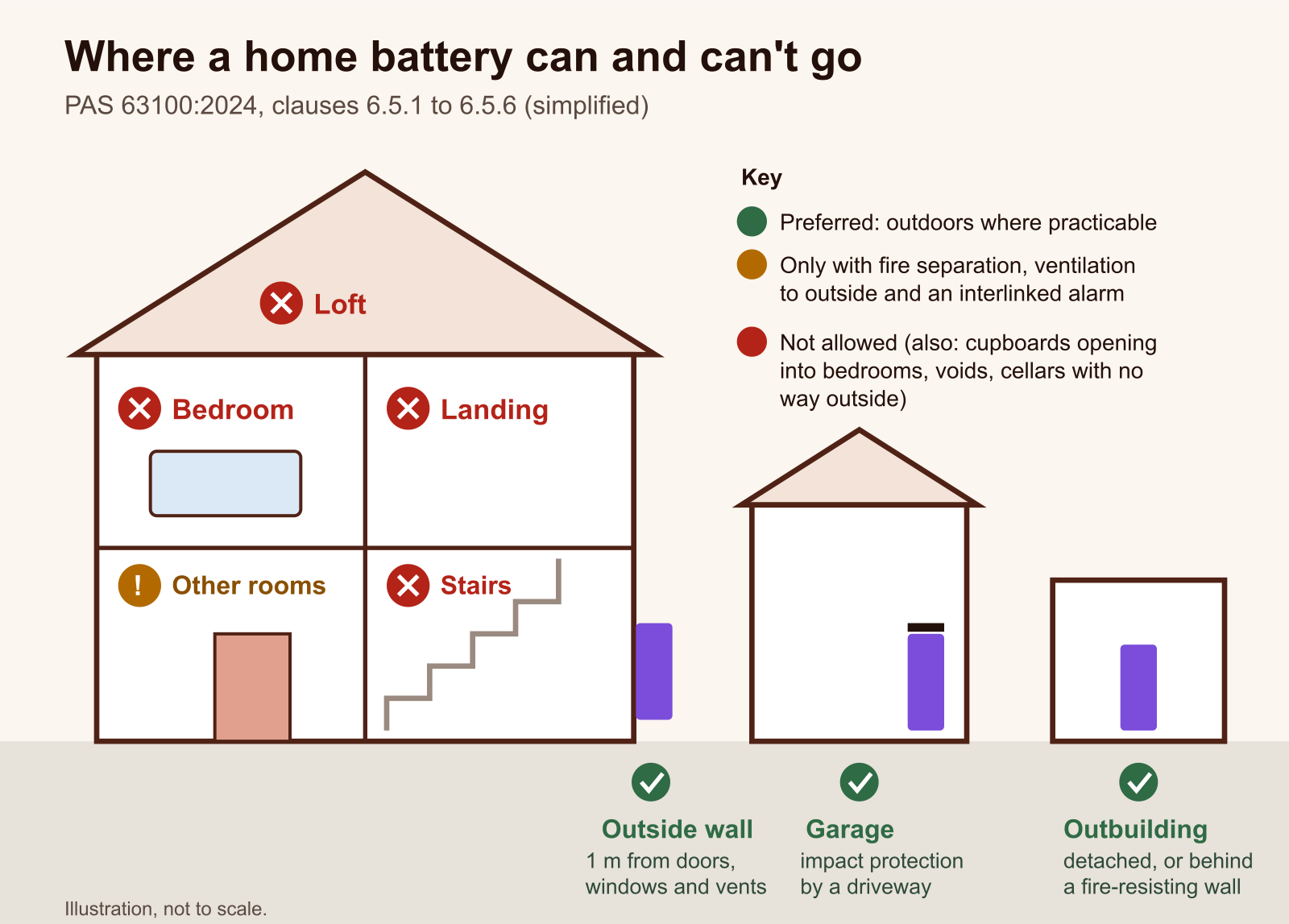
- Where the battery goes. The fire-safety specification for home batteries, PAS 63100, rules out lofts, bedrooms and escape routes, and asks for a minimum distance from doors and windows. A garage or outside wall can mean extra protection or a longer cable run.
- How it connects. Adding a battery to panels you already have usually means its own inverter (AC coupling); fitting one with new panels can mean a single hybrid inverter. The two are priced differently.
- Backup in a power cut. Not every battery keeps the lights on when the grid goes down. Backup needs extra switching and sometimes a separate circuit, which adds parts and labour.
- The network paperwork. Storage over 3.68 kW needs a G99 application to the network operator before installation, according to MCS; smaller systems can be notified within 28 days afterwards. The longer route adds time and admin.
Usable capacity matters too. A cheaper battery that lets you use less of its label size can cost more for each kWh you actually store.
Test any quote against the official median
The quickest check is a division: the quote total over the battery's nominal kWh. Set the result against the median for its band in the table above. Our quote checker does this for you and, if you add the usable capacity from the spec sheet, works out the price per usable kWh as well.
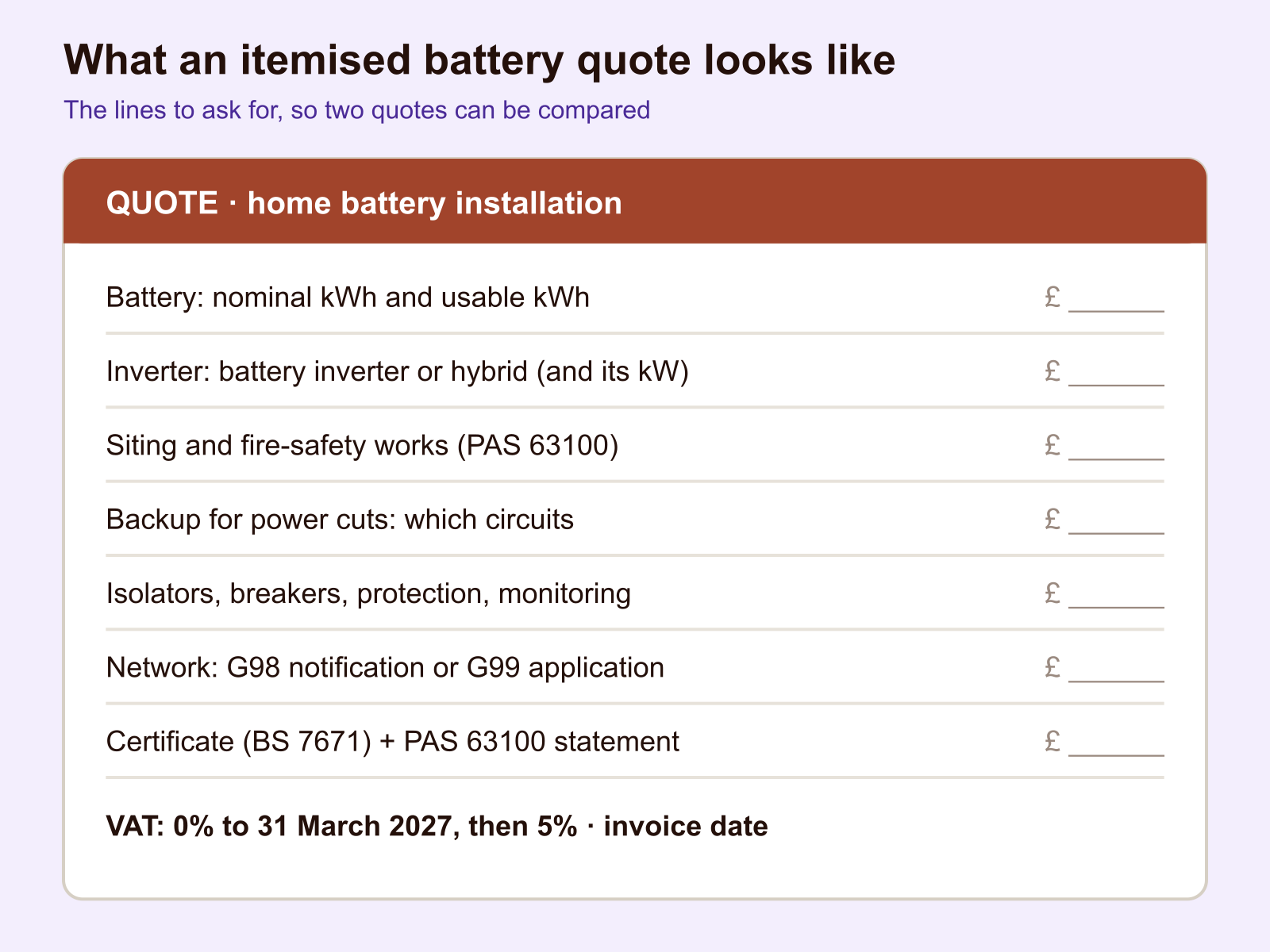
A figure above the median deserves an itemised quote, not suspicion. Ask for the battery, the inverter, the siting works, the network application and the certificate as separate lines. Ask which edition of the Wiring Regulations the installation certificate will be issued against, now that Amendment 4 to BS 7671 adds a chapter on batteries.
Then check the firm. Look it up on the MCS installer register and make sure battery storage is listed, not just solar panels. Ask which consumer code it belongs to (RECC and HIES are two you may see named), what the warranty covers and for how many years, and who honours it if the installer stops trading. Our list of questions to ask before signing goes through each one.
VAT on an installed battery: 0% until 31 March 2027, then 5%
HMRC's notice on energy-saving materials zero-rates the installation of a battery in a home until 31 March 2027, whether it stores solar power or charges from the grid. From 1 April 2027 the rate becomes 5%. On a 10 kWh battery at the modelled price that is the difference between about £8,800 and about £9,200.
That is a real change with a date, but it is 5% of the price, not a reason to buy in a hurry. A battery that doesn't suit your tariff and how you use power won't be made worthwhile by a VAT date. Buying a battery without having it fitted gets no relief at all: a box bought from a shop is charged at the standard rate. The VAT page covers invoice dates, deposits and mixed jobs.
How people pay for a battery, and what isn't a grant
Most households pay from savings. For everyone else, three things are worth knowing:
- No national grant pays for a home battery in England, Wales, Scotland or Northern Ireland. The Boiler Upgrade Scheme pays towards heat pumps, never batteries.
- The Warm Homes Loan Scheme is a loan. The government's factsheet lists a battery cap of £15,000, and the work must be done by an MCS-certified installer. You apply through a participating lender or installer. This site is not a lender, names no lenders and arranges nothing.
- Warm Homes: Local Grant, run by councils in England for some lower-income homes, can include a battery, but only alongside solar panels.
More detail, including what installer finance usually looks like, is on paying for a battery.
Read the price per warranted kWh, not just the total
A battery warranty usually promises a number of years and a total amount of energy the battery can put through. Divide the price by that energy figure and you get a cost per warranted kWh: what each unit of storage costs you over the warranty. It is a way to compare two quotes on more than the headline, not a saving.
Two batteries at the same price can come out very differently. One with a larger usable capacity and a higher throughput promise costs less for each kWh it is warranted to store. The price per kWh page shows the sum with the figures from your own warranty document.
The year-one bill effect depends on two prices on your own tariff
A battery with solar earns its keep by storing power you would otherwise export, so each stored kWh is worth roughly your import price minus your export price. A battery on its own works on the gap between your peak and off-peak rates, less what is lost charging and discharging.
Ofgem's price cap put the average Direct Debit unit rate at 26.32p per kWh from 1 October to 31 December 2026. Export rates under the Smart Export Guarantee are set by each supplier and must be above zero; they vary widely, so we never quote one as the rate.
Because every input depends on your own tariff and usage, this site gives a year-one figure only when you enter your own numbers, caps the share of solar a home can use itself at 75% without a battery and 90% with one, and never turns it into a payback period. Try it in the year-one bill effect guide.
Prices for the battery you are actually pricing
The size bands are the start. The rest of the site breaks the price down by situation: the price of a small battery under 6 kWh, where the fixed costs of any installation weigh heaviest; the 10 kWh battery price in the band most households buy; and the large home battery price, the fastest-growing band, where the network application and the per-home storage limits start to matter.
If you already have panels, adding a battery to existing solar covers the retrofit prices that the official series measures. If panels and battery are going in together, solar and battery prices shows how to split the bill, since the official battery figures leave the panels out.
Solar battery price questions
How much does a solar battery cost in the UK?
DESNZ's official figures for home batteries registered with MCS put the middle installed price at £1,300 per kWh for batteries under 6 kWh, £890 per kWh for 6 to 11 kWh and £630 per kWh for 11 kWh and over (April 2025 to March 2026). On those figures a 5 kWh battery comes to about £6,500 fitted and a 10 kWh battery about £8,800, at 0% VAT (to 31 March 2027).
Does that price include the solar panels?
No. DESNZ counts the battery, fitting it and connecting it to the supply. Panels, extended warranties and other building work fitted at the same time are left out, so a solar-plus-battery quote is two prices added together.
Why does a small battery cost more per kWh?
Every installation carries costs that barely change with size: the visit, the wiring, the isolation and protection, the certificate and the paperwork for the network operator. Spread over fewer kWh, those costs push the price per kWh up, which is why the under-6 kWh band has the highest median.
Is there a government grant for a home battery?
No national grant pays for a home battery anywhere in the UK. Some lower-income households in England can get a battery through Warm Homes: Local Grant, and only alongside solar panels. The Warm Homes Loan Scheme is a loan you repay, not a grant.
Will batteries get dearer after March 2027?
The VAT on an installed home battery goes from 0% to 5% on 1 April 2027 unless the government extends the relief. On the same pre-VAT price that adds 5%: about £440 on a 10 kWh battery at the modelled price. Prices themselves can move either way.
How do I know if my quote is fair?
Divide the total by the battery's nominal kWh and compare the result with the official median for its size band. A quote above the median is not wrong in itself, but it should come itemised so you can see which extras account for the difference. The quote checker on the price per kWh page does the sum for you.
Who runs this site?
SEO-DONS LTD (company 16766013), an independent publisher. It does not sell, fit or finance batteries and holds no trade accreditation. Every price on the site is taken from DESNZ's official statistics, or marked as a secondary source where it is not.
Sources (page last reviewed 3 November 2026)
- DESNZ: MCS certified domestic battery installation statistics (April 2024 to March 2026 workbook, published 28 May 2026), checked 3 November 2026.
- HMRC: VAT on energy-saving materials and heating equipment (Notice 708/6), sections 2.1, 2.3 and 2.19, checked 3 November 2026.
- HMRC: extension of the energy-saving materials relief to electrical batteries (from 1 February 2024), checked 3 November 2026.
- BSI / DESNZ: PAS 63100:2024, battery energy storage systems in dwellings (PDF), checked 3 November 2026.
- IET: Amendment 4 (2026) to BS 7671:2018 published 15 April 2026, checked 3 November 2026.
- MCS: notifying distribution network operators (G98 and G99), checked 3 November 2026.
- MCS: find an installer (the public register), checked 3 November 2026.
- GOV.UK: Warm Homes Loan Scheme factsheet (published 27 October 2026), checked 3 November 2026.
- GOV.UK: apply for Warm Homes: Local Grant, checked 3 November 2026.
- Ofgem: energy price cap unit rates and standing charges (1 October to 31 December 2026), checked 3 November 2026.
- Ofgem: Smart Export Guarantee (SEG), checked 3 November 2026.
- Which?: solar panel battery storage (secondary source, page updated 30 October 2026), checked 3 November 2026.
Want quotes to hold up against these figures?
Tell us the battery size you are pricing and your postcode. Your enquiry reaches SEO-DONS LTD, the company that publishes this price guide, and we reply by email. Sending it costs you nothing and commits you to nothing.
What happens next
- SEO-DONS LTD, the publisher of this price guide, receives your enquiry.
- We read what you sent and answer by email.
- You decide what, if anything, happens next.